Friday was exciting for Sun Belt Basketball. It was a terrible day for App State’s hoops teams, who lost by a combined 56 points to cap multi-game losing streaks. But now is the Sun Belt Tournament, so wipe the slate clean, it’s time to win or go home.
For both the men and women, App State got the sixth seed and will start their Sun Belt Tournament this Friday in Pensacola. Due to the new ladder-gauntlet bracket, both teams will have to win four games in four days, two of those against teams playing their first game, to stand tall on Monday.
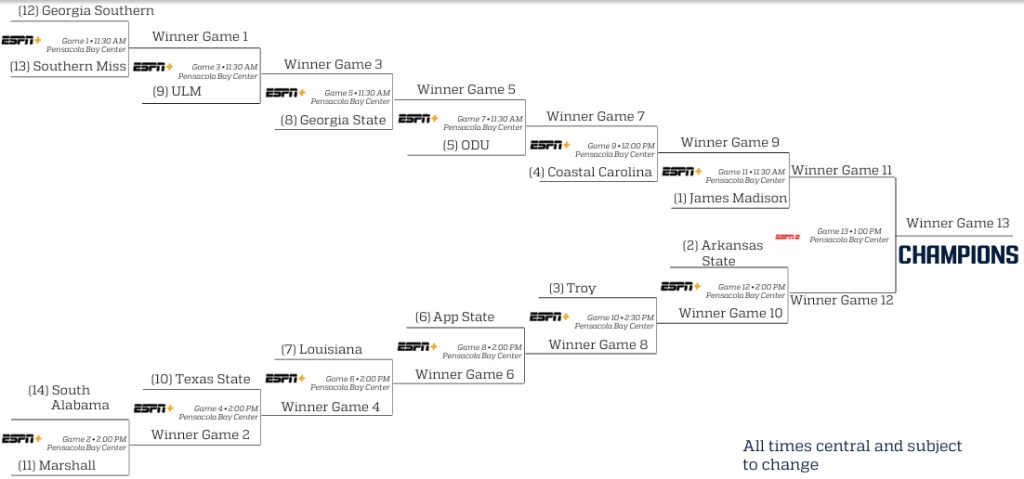
Women’s bracket above per Sun Belt Sports dot org
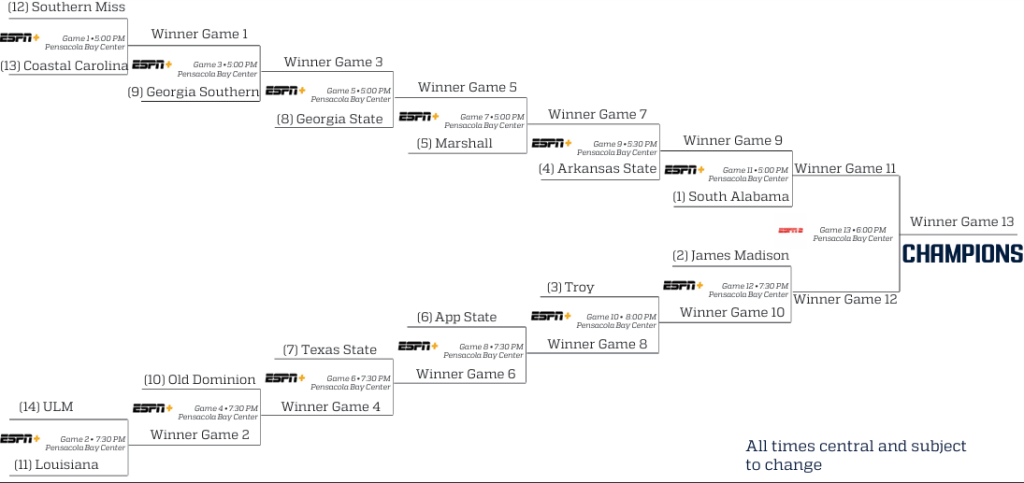
Men’s bracket above per Sun Belt Sports dot org
There were multiple ties in the standings for both genders. There was a four-way tie for first place in the men’s standings, meaning two champions must play an extra game.
The App State women were in a tie for fifth at 9-9 with Old Dominion and Louisiana.

Source: espn.com
How do you break this tie? We go to the most popular Sun Belt Conference webpage over the last few days, the tiebreaker page. This is linked from the men’s and women’s basketball home pages.
TOURNAMENT SEEDING
The seeds for the Men’s and Women’s Basketball Championship shall be determined based on each team’s overall regular-season conference finish. The regular-season champion shall earn the top seed. The remaining seeds are then determined based on their conference winning percentage. Once all seeds are determined, the seeds will be placed accordingly into the bracket.Three or More Teams Tiebreaking Formula
A. Highest win-loss percentage of the tied teams against each other is first considered.
B. Each teams’ win-loss percentage vs. the team occupying the highest position in the final regular-season standings, and then continuing down through the standings until one team gains an advantage.
C. When arriving at another group of tied teams while comparing records, use each team’s record against the collective tied teams as a group (prior to that group’s own tie-breaking procedure), rather than the performance against individual tied teams.
D. If there is still a tie, the seeded position of the teams will be determined by a draw conducted by the Sun Belt Conference Commissioner.
E. For all ties involving three or more teams, once the tie is broken and the highest-seeded team is determined, the remaining tied teams will revert back to the beginning of the applicable tiebreaker.
Thus, we start at A, “Highest win-loss percentage of the tied teams against each other is first considered.”
There were three games involving two of these three teams. Old Dominion beat App State 78-71 on Jan. 15, App State beat Old Dominion 74-66 on Jan. 23, App State beat Louisiana 61-52 on Jan. 30.
Thus, App State is 2-1, ODU is 1-1 and Louisiana is 1-1. According to the above tiebreaker, that means App State is No. 5. Then you start over for ODU and Louisiana because according to E, “For all ties involving three or more teams, once the tie is broken and the highest-seeded team is determined, the remaining tied teams will revert back to the beginning of the applicable tiebreaker.”
ODU beat second-place Arkansas State while Louisiana went 0-2, so ODU would be No. 6 and Louisiana No. 7.
According to the above women’s bracket, this is not the case. ODU is No. 5 and App State is No. 6.
The Sun Belt hasn’t explained how their tiebreakers were used in their press releases announcing the brackets (for either gender BTW) and my late Friday emails to App State and the Sun Belt Conference were not returned by Sunday.

Source: https://sunbeltsports.org/sports/2014/1/24/BasketballTieBreakers.aspx
What I believe happened is that the Sun Belt disregarded multi-team head-to-head since ODU and Louisiana didn’t play (every east team misses playing a west team each season. For instance, App State WBB did not play Texas State this season). Thus, it appears the Sun Belt went to B, “Each teams’ win-loss percentage vs. the team occupying the highest position in the final regular-season standings, and then continuing down through the standings until one team gains an advantage.”
No one beat first-place JMU, so you go to second-place Arkansas State. Louisiana lost twice while both App State and ODU beat the Red Wolves.
Here’s where it gets even more wiggy. Since one team didn’t gain an advantage in the tiebreaker versus Arkansas State, you go to the next team in the standings. But since Louisiana lost to the other two, are they still in the tiebreaker?
The Sun Belt seems to argue the Cajuns are not still in the tiebreaker, despite nothing in their tiebreakers saying otherwise. This is because, versus third-place Troy, Louisiana went 1-1 while App State and ODU both went 0-1. Thus, you could make the argument Louisiana should be No. 5 instead of No. 7.
Instead, the Sun Belt appears to have taken just App State and ODU to the tiebreaker versus Troy, then to versus fourth-place Coastal Carolina. Both teams went 1-1, so you move to Louisiana, which due to ODU not playing them doesn’t break the tie, so against eighth-place Georgia State. ODU went 1-1 while App went 0-2 versus the Panthers (both losses I saw live). Thus, ODU is No. 5, App State is No. 6.
Skipping head-to-head makes sense in a two-team tiebreaker for obvious reasons, but in a multi-team tiebreaker, it makes less sense.
You can argue it isn’t fair to consider multi-team head-to-head since two of the three teams didn’t play each other. But look at the above tiebreakers. That’s the entirety of the webpage. There’s no consideration for two teams in a multi-team tiebreaker. Neither is their consideration for dropping a team off once they fall below the other teams in a certain tiebreaker.
I believe this same Sun Belt interpretation was also done in the men’s bracket to break the four-way tie for eighth place between Georgia State, Georgia Southern, Louisiana and Old Dominion. Even the websites dedicated to breaking ties have it that way.

Source: bball.notnothing.net
Here, all four teams had played each other, so head-to-head mattered and they seem to have taken GSU and GSU out once they both had the same record in that tiebreaker, then recycled Georgia Southern back in to break the tie for ninth once Georgia State won the eighth-place tiebreaker.
If you take the Sun Belt tiebreakers literally in the way I felt was right, all four of those teams would go the tiebreaker B and C, where all four would compare records versus the four-way tie for first place (Arkansas State, South Alabama, Troy and JMU, who’s seeding tie was all broken in head-to-head).
In that, ODU would have won and been eighth with a 1-3 record (UL 1-5, GaSo 0-4, GSU 0-5), then Louisiana would be ninth (GaSo and GSU had 2-1 records in a GaSo/GSU/UL group so you go to B and C, then UL has a better record versus the first-place group. For 10th, GaSo and GSU would go to record versus fifth-place Marshall and G-State would win by being 1-1 while G-Southern was 0-2.
If you take the interpretation I used above, and sparked my whole reason for writing this blog, for the women’s tiebreaker and apply it to the men, you’d have No. 8 ODU, No. 9 UL, No. 10 GSU, No. 11 GaSo.
But what do I know? My office isn’t in the Superdome where the Super Bowl was just held and will host Wrestlemania next year. At least you can read my writings clearly, unlike the league’s unreadable social media bracket graphics.
 pipedreams
Leave a comment